Outdoor Lighting · Preventive Maintenance
Miami’s Fall Clock Change: Outdoor Lighting Maintenance That Continues All Year
EVONEX Group LLC ·
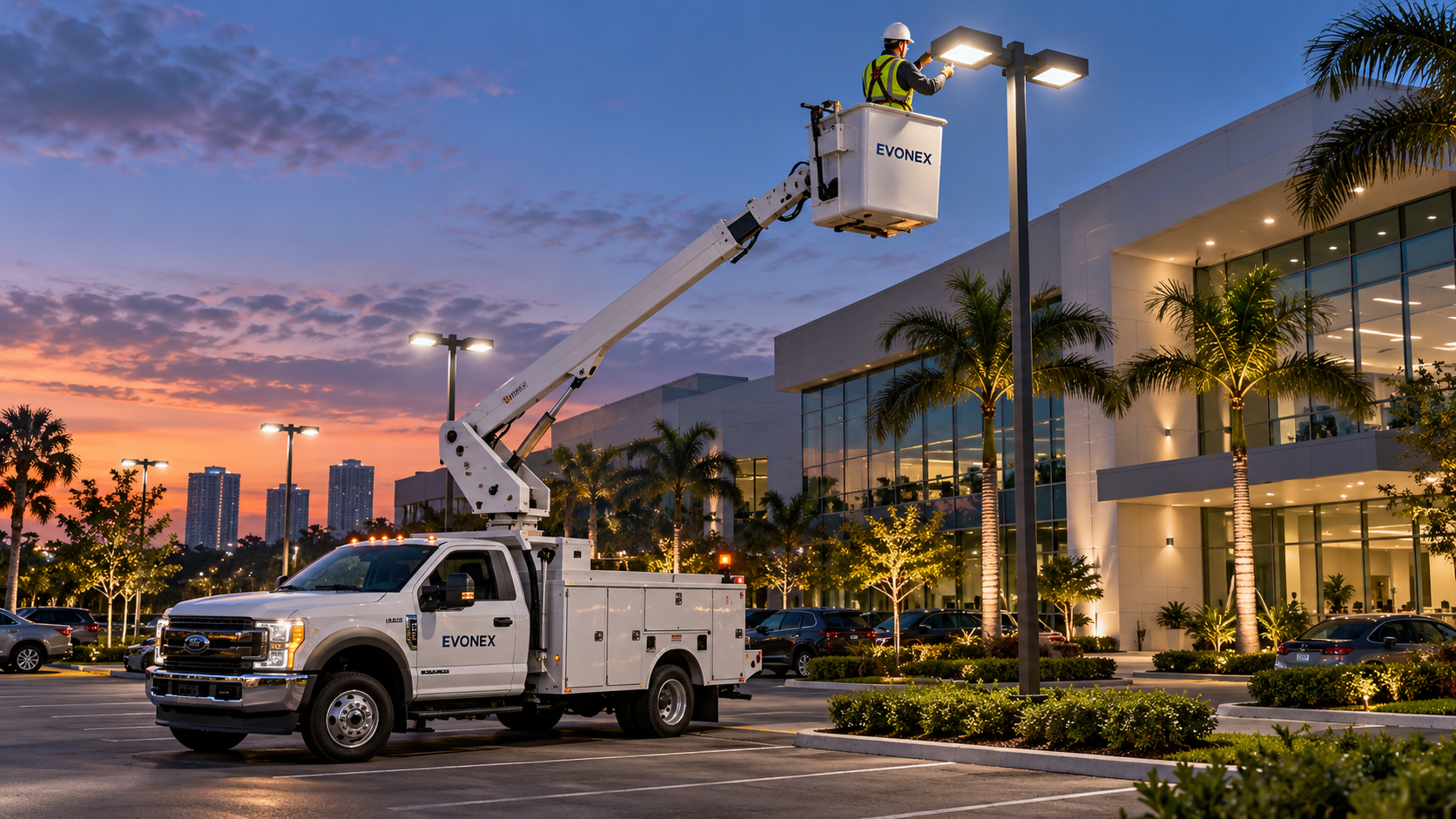
When Miami returns to standard time in autumn, a property’s evening lighting can appear out of step with the clock. Residents may arrive home after dark, customers may cross a dim parking area, or a walkway may remain unlit while a timer follows an old schedule. The useful response is not simply moving every setting back an hour. It is checking how the controls work, what the property needs and whether the lighting equipment is healthy. For Miami-Dade condominiums, HOAs, property managers, businesses and homes, the seasonal review should become part of ongoing preventive electrical maintenance.
What changes: daylight versus the displayed time
Daylight changes gradually through the seasons. Returning to standard time changes the hours displayed on clocks; it does not suddenly change the sun’s position or remove an hour of sunlight. Under current U.S. rules, the autumn transition moves clocks back one hour. Sunset consequently appears earlier by the clock after the transition.
Avoid adopting a universal Miami switch-on time. The date, location, surrounding buildings, shade and weather influence useful visibility at a particular property. Verify any sunrise or sunset reference for the relevant date and location, then compare it with actual conditions. A fixed schedule and a daylight-responsive control need different checks.
Start with the spaces people actually use
Map entrances, sidewalks, stairs, drive aisles, parking spaces, mail areas and routes between buildings. In a condominium or HOA, note shared pedestrian paths and access gates; at a business, include customer entrances and employee departure routes. At home, look at the driveway, front steps and side passage from a safe position.
Observe the property around dusk and again after dark without entering electrical equipment or climbing. Record which lights are off, flickering or operating at unexpected hours. Describe the location precisely rather than reporting only ‘the parking lot is dark.’ A fixture number, nearby entrance and dated photo help a professional locate the concern.
Photocells: check the light they actually sense
A photocell responds to ambient light rather than simply following a displayed clock time. It may therefore track dusk without a one-hour manual correction. But shadows, dirt, vegetation or light from a nearby fixture can affect what the sensor detects. A sensor exposed to the light it controls may behave differently from one with a clear view of natural light.
Report daytime operation, late activation or repeated cycling. A professional can evaluate sensor placement, condition, compatibility and switching behavior against the equipment’s instructions. Do not cover sensors as a permanent workaround, bypass a control or open a weatherproof enclosure yourself. The problem may involve the circuit or fixture, not just the photocell.
Timers: review the whole schedule
Mechanical and digital timers follow programmed settings. Depending on the model, a digital timer may adjust automatically for daylight saving time, require a manual change or lose settings after a power interruption. Check the model documentation instead of assuming every controller behaves alike. Have the professional review clock accuracy, day-of-week schedules, seasonal settings and any overrides.
A correct clock does not necessarily mean a useful lighting schedule. A store’s closing time, a condominium’s access needs and a home’s evening use differ. Confirm the intended operating period with the owner or manager. Document approved changes and verify actual operation afterward, rather than treating the programming screen as proof that every fixture works.
Astronomical clocks: verify location and configuration
An astronomical clock calculates switching times from the date and configured location. Its usefulness depends on correct location, time zone, daylight-saving settings and any sunrise or sunset offsets. Some systems combine astronomical schedules with photocells or other controls. An automatic label alone does not establish that the installation is configured correctly.
Ask the professional to compare the controller’s configuration with its manual and the property’s required operating hours. Check whether a manual override or power loss changed operation. Record the approved configuration for future visits. Avoid copying another property’s offsets: a shaded walkway and an open parking lot can require different assessment.
Exterior LED lighting still needs maintenance
LED fixtures can develop driver, connection, control or enclosure problems. Visible symptoms include intermittent operation, unexpected dimming and sections that no longer illuminate consistently. A replacement lamp or brighter fixture will not necessarily resolve a wiring or control fault. Diagnosis should distinguish the light source from the equipment supplying and switching it.
In Miami-Dade, rain, humidity and coastal exposure where applicable deserve attention when evaluating exterior equipment. A professional should assess water intrusion, corrosion, seals, mounting and suitability for the location. LED compatibility with existing controls also matters. For a planned conversion, review fixture distribution and circuit conditions before selecting products.
What to check before an LED lighting retrofit →Common areas and parking lots: visibility without excess glare
More light is not automatically better light. Glare can make it harder to see pedestrians, curbs or changes in level; uneven coverage can leave dark gaps beside bright fixtures. Assess the actual route and fixture arrangement rather than judging performance from a single view beneath a pole. Consider light spilling into neighboring windows as well.
For condominium boards and commercial managers, separate observed conditions from any required lighting criteria. A qualified assessment can identify applicable requirements and whether measurements or a design review are needed. Inspection and maintenance can support visibility and help identify hazards; they do not guarantee safety, prevent crime or replace other property responsibilities.
Parking lot and pole lighting service →Keep electrical hazards out of the DIY checklist
Do not open panels, remove fixture covers, touch exposed conductors, work on energized circuits or climb poles to investigate. Repeated breaker trips, burning smells, damaged equipment, exposed wiring and water around electrical equipment require professional attention. Keep people away from the affected area and follow the property’s safety procedures. An immediate threat to life or fire calls for emergency services.
A professional inspection may include appropriate circuit testing, connection and protection checks, control evaluation and equipment assessment. Work at height requires suitable access arrangements and control of the surrounding area. Parking-lot service may need coordinated vehicle access, pedestrian separation and an approved work window. These are planning requirements, not instructions for an owner to perform electrical repairs.
Safe observations before electrical troubleshooting →Make preventive maintenance continuous, not just seasonal
A fall review is a useful starting point, not a complete maintenance program. Set an inspection interval according to equipment condition, exposure, manufacturer guidance, property use and professional findings. Combine scheduled reviews with follow-up after reported faults, relevant storms, landscape changes or alterations to the lighting system. There is no single interval suitable for every Miami-Dade property.
Repeated inspections can reveal patterns: the same fixture cycling, a control repeatedly losing time or corrosion progressing between visits. Identifying these issues earlier can support repair planning and reduce avoidable surprises, without guaranteeing savings or uninterrupted operation. Keep unresolved findings on a follow-up list until the next action is confirmed.
Document findings and coordinate the next visit
Maintain a simple lighting inventory with fixture locations, control types, operating expectations, inspection dates and reported symptoms. Separate recommended repairs from completed work. After a control adjustment or replacement, arrange an operating check during the relevant lighting period. A daytime visit alone may not show the visibility problem that residents experience at dusk.
For condos, HOAs and managed properties, identify the person who approves work, the access contact and any parking or entry restrictions. Share recent observations and available equipment information when requesting service. EVONEX can discuss outdoor lighting maintenance for Miami-Dade properties through the existing service request process; scope, access and scheduling are confirmed for the individual property.
References
Need Outdoor Lighting Maintenance in Miami? Call EVONEX Group LLC (786) 451-7011
Same-day appointments subject to availability