Electrical Panels · Capacity & Planning
Electrical Panel Repair in Miami: When Should You Repair or Upgrade an Older Panel?
EVONEX Group LLC ·
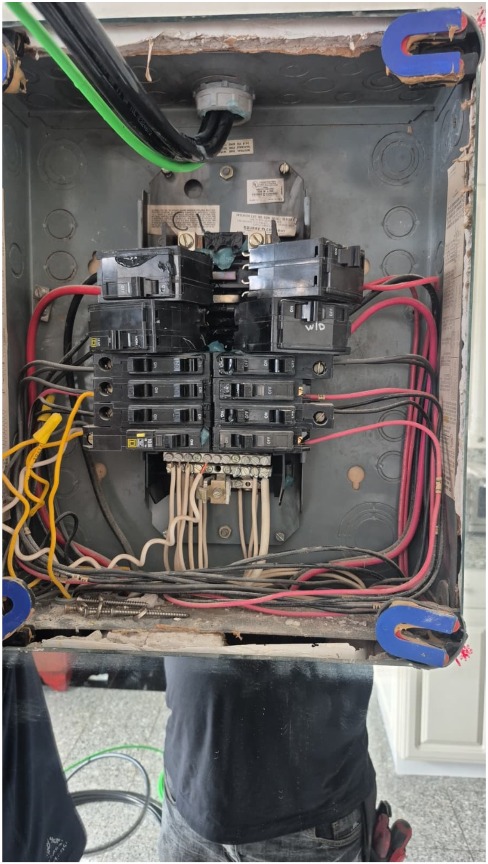
Searching for electrical panel repair in Miami usually starts with a practical concern: damaged equipment, unreliable power or plans for a renovation. The answer is not automatically a larger panel. A licensed electrician needs to distinguish the condition of the equipment from the capacity of the electrical service and individual circuits. For an older Miami-Dade home, a useful evaluation connects what is installed today with the loads already operating and the equipment you intend to add. That distinction helps owners choose a justified repair, replacement or capacity upgrade instead of treating all three as the same job.
Older Miami homes: review changes, not just age
Many Miami-Dade homes were built decades ago, and some retain older electrical panels. Their electrical demands may have changed through kitchen renovations, laundry equipment, additions or central air conditioning installed later. Those changes may have occurred without a complete service or panel upgrade. This is a reason to review the property's history, not proof that its original equipment is unsafe.
Panel age alone does not require replacement. Condition, compatibility, capacity and the applicable requirements matter. Gather renovation records and equipment information if available. A home that operates normally may still need planning before a major new load; a home with repeated breaker trips needs diagnosis even when no renovation is planned.
Service capacity, panel rating and circuit space
The electrical service supplies the property; the panel distributes power to branch circuits. Its rating is only one part of the picture. Service conductors, the main disconnect, meter equipment and other components can constrain the usable capacity. Installing a higher-rated panel does not, by itself, increase the service available to the house.
Empty breaker spaces also do not prove spare electrical capacity. Conversely, a full panel does not automatically mean the service is overloaded. Space, electrical demand and equipment condition are separate questions. Ask the electrician to explain each one and identify whether the issue is local to a circuit, the panel or the entire service.
Central AC, renovations and added electrical loads
An added or replaced central AC system deserves review using the selected equipment's nameplate and installation requirements. A newer unit is not automatically a larger load, and cooling size alone is not an electrical calculation. Its required circuit protection and conductors must suit the actual equipment, not assumptions about the previous installation.
Discuss future electric cooking, water heating, EV charging or other substantial additions before work begins. A code-based load calculation considers the relevant existing and proposed loads, including applicable demand factors. Do not simply add breaker handle ratings or use a quiet afternoon's consumption as the capacity test. Never increase breaker or service amperage without professional load assessment and verification of the affected equipment and wiring.
Corrosion, moisture and visible panel damage
Miami-Dade humidity, water intrusion and coastal exposure where applicable can contribute to deterioration. Corrosion, damaged enclosures, heat discoloration or evidence of moisture merit professional investigation. The electrician should look for the cause as well as the affected parts; replacing a component while leaving a leak unresolved may not address the underlying problem.
The original photograph above shows existing panel damage, not a completed upgrade or a model for a new installation. A photograph cannot establish whether equipment is energized, how extensive hidden damage is or which repair is appropriate. Do not remove covers to collect pictures. Describe what is visible from a safe distance with the equipment closed.
Repair versus replacement versus upgrade
Repair addresses a specific defect when the remaining equipment is suitable: for example, an approved compatible breaker or a repairable enclosure issue. The recommendation depends on inspection, testing, manufacturer requirements and the condition of the connection points. A damaged bus or unavailable suitable parts may rule out a simple component repair.
Replacement changes the panel or other equipment because of condition, compatibility or an otherwise justified need. It can retain the existing service capacity. An upgrade changes the installation to support a different capability, such as additional circuit space or increased service capacity when supported by the evaluation. The scope may overlap, but these terms are not interchangeable. Ask exactly what changes and what remains before approving a proposal.
What a licensed electrician should evaluate
An electrical panel upgrade in Miami should begin with findings rather than a predetermined amperage. The evaluation may include identification of equipment and ratings, load calculation, condition of breakers and bus connections, conductor suitability, grounding and bonding, circuit protection and the requirements triggered by the proposed work. The final scope depends on the property and applicable rules.
Ask for a clear explanation of the diagnosed problem, the options, and any limitations of the inspection. Distinguish an appliance or branch-circuit fault from a service-capacity concern. Request an itemized scope identifying affected equipment and any further investigation. A symptom such as dimming during AC startup is useful information, but it does not establish a panel diagnosis by itself.
Panel evaluation, repair and upgrades in Miami →Permits, inspection and utility coordination
Panel and service work can require electrical permits and inspections. Confirm requirements with the authority having jurisdiction: the county or municipality responsible for the property. Do not assume one city's process applies throughout Miami-Dade. Ask who obtains permits, what inspections apply and what documentation you should receive when the work is completed.
Changes involving the service connection, meter equipment or utility-owned facilities may also require utility coordination. Planned disconnection and reconnection arrangements should be confirmed before scheduling. Ask whether power must be interrupted and how occupants will be notified. Do not assume a panel appointment means the utility has already approved a service increase or arranged a reconnection.
Questions for homeowners, condo owners and landlords
Homeowners should ask which existing loads are included, whether planned renovations change the recommendation and whether repair resolves the identified defect. For an old electrical panel in Miami, useful questions are: Are suitable replacement parts available? Is capacity actually insufficient? What evidence supports replacement instead of repair? What work outside the panel would an upgrade require?
Condo owners should establish whether the panel serves their unit or whether shared service equipment is involved. Coordinate access and authorization with management rather than assuming unit ownership permits changes to common equipment. Landlords should document tenant-reported symptoms, arrange lawful access and communicate planned interruptions. Discuss medical-equipment backup needs through the occupant's established plan; no electrical repair appointment guarantees uninterrupted power.
Repeated trips and emergency warning signs
A breaker trip does not automatically mean fire or prove that the whole panel needs replacement. It can reflect an overloaded circuit, appliance fault or another condition. Repeated trips should be evaluated by a licensed electrician, not addressed with repeated resets or a higher-amperage breaker. Keep the focus on finding the cause rather than defeating protection.
Never open an energized panel, remove covers or touch exposed parts. If you notice smoke, sparks, burning odor or intense heat, move away, keep others away and call 911 when appropriate. Do not approach the panel to investigate or attempt a shutdown in unsafe conditions. Panel repairs and internal inspection belong to qualified professionals using appropriate safety procedures.
Repeated breaker trips and warning signs: safety guide →Electrical panel repair: homeowner FAQs
Does an older panel always need replacement?
No. Age alone is not the deciding factor. Condition, compatible components, load assessment and applicable requirements guide the recommendation.
Will a new panel provide more electrical capacity?
Not necessarily. A replacement can keep the same capacity. Increasing service capacity requires assessment of the complete service and utility coordination where applicable.
Should I upgrade the panel when replacing central AC?
Not automatically. Have the selected AC equipment and existing loads evaluated. Its electrical requirements determine circuit needs; a load calculation informs service-capacity decisions.
Can one damaged breaker be repaired without replacing the panel?
Sometimes a compatible replacement is appropriate, but damage to the bus or connections can change the scope. Testing and inspection must determine whether the surrounding equipment remains suitable.
How do I arrange an electrician in Miami for panel evaluation?
Call EVONEX or use the existing service request form with the property location, symptoms and planned loads. Scope and scheduling are confirmed individually; same-day appointments are subject to availability.
References
- Miami-Dade County — Electrical permits
- Miami-Dade County — Work-with procedure
- CPSC — Guide to Home Wiring Hazards
Call EVONEX (786) 451-7011
Same-day appointments subject to availability